To speed up AI research, we have to shorten
the loop from idea to feedback.
That lets us test more ideas, learn faster, and push the frontier along the way. Agents will be at the core of that process, performing the gruntwork, guided by the scientist’s hand. Rapidreview is building systems to make this approach easier.
 Lambda
 AWS
AWS Google Cloud
 Azure
Azure RunPod
 Modal
ModalThe Feedback Loop
The atomic unit of scientific research is testing a novel idea and learning from the outcome. Repeated, it accumulates knowledge and leads to better ideas, pushing the frontier of understanding and performance. Everything else in a lab exists to serve that test.
The shorter the loop from idea to feedback, the faster we iterate. The group with the tighter loop asks better questions, because every answer arrives while the question is still fresh.
Agents change both halves of the loop: a raw idea gets polished against previous research and experiments, and execution is automated to preserve the scientist’s focus. Better experiments and faster execution compound into more signal to learn from — and every run leaves reliable data behind for the runs that follow. The figure above is our whole argument. Everything we build lives somewhere on it.
Ideation
Novel ideas are the prerequisite for any significant advance in research. They arise from human ingenuity — in creative ideation, we will hold an edge over AI models for the foreseeable future. Relevant evidence is required to sharpen an idea or kill it before allocating resources. Retrieving that evidence is a search and reasoning task — the type of work agents do well, and one they can do at scale.
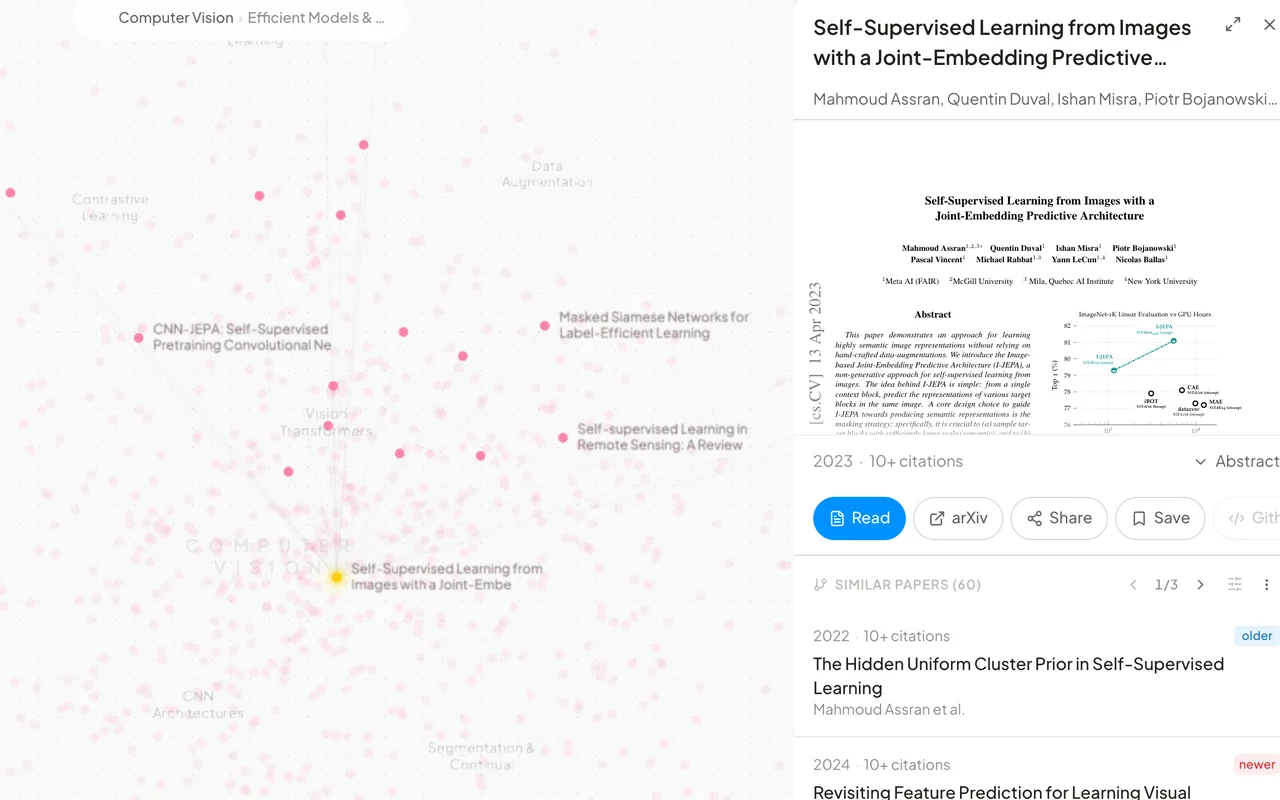
So that is what we build. A living map of research — every dot a paper, edges shared ideas or citations. Indexed for agent swarms to search, visualized for humans to understand. Its search and recommendation engine hands every new experiment the right prior research. Most wasted compute is an experiment that needed a better design; better designs start by consulting what the field already knows.
Execution
Agents excel at completing well-defined tasks with set evaluations; engineering-dominant fields such as AI research are well suited for their use. Working with agents raises two significant challenges: reliability and visibility. Advanced models are known to pursue the shortest path to success by cheating the process, or quietly adjusting the goal to reach it in fewer steps. When agents execute in parallel, this compounds into a visibility problem for the scientist: results are easier to trust when you can see how they were reached, and the decisions made along the way carry lessons worth surfacing.
Agents run the experiments.
Our approach to agentic execution centers on gating mechanisms: independent adversarial reviews injected at key moments, and machine-verifiable artifacts required throughout the run. The artifacts power the user interface, whose job is to tell the story of the experiment: what was tried, what was decided, and why, so scientists can understand the agents’ work. With every run gated and decisions visible, delegating parallel experiments to agents becomes a viable approach to accelerating research, so the loop can be tighter and knowledge accumulated faster.
Hardware
Compute is a chokepoint for AI research. Flexibility about the source can relieve that pressure: a Lambda cluster, a single cloud GPU, the university machine, or a personal laptop. Prices, availability, and accessibility vary significantly. A team ready to run anywhere can squeeze in more training runs. We built the framework to run on whatever is within reach.
Two Complementary Instruments
Nisa is a living network of 500,000+ ML paper nodes and twenty million edges, drawn from direct citations and idea-level overlap. It is indexed for agents to trace how ideas developed, find gaps, and surface best practices; its built-in agents produce deep dives into niche ML topics. Use it directly as a research tool, or point your own research agents at it through the CLI (docs) when they need to consult the literature. rapidreview.io/nisa
Nisa is the ideation half. Merv is the execution half.
Merv is a plugin that converts your agent into an ML researcher. It was built against the two things research agents need the most: reliability and visibility. Agent harnesses and frontier models get better at executing tasks every month, so Merv is not an agent harness. Instead, it is the gating mechanism that forces your agent to produce evidence and undergo adversarial reviews during research, while providing the necessary resources: GPU sandbox orchestration, large object storage, and a UI for the scientist to observe the work. It is open source and compatible with most agent platforms, including Claude Code, Codex, Cursor, and Kilo Code.
Both are in daily use on our own research.
Join Us
If you’re passionate about solving inefficiencies in AI research, we’re hiring MTS across research and engineering.