

 Merv
Merv Nisa
NisaConfigure a provider
Open your project in the web UI and go to Settings → Compute. Add a provider, paste its credentials, and click Verify. Then enable it and set a daily USD limit. The limit is your backstop if an agent leaves machines running.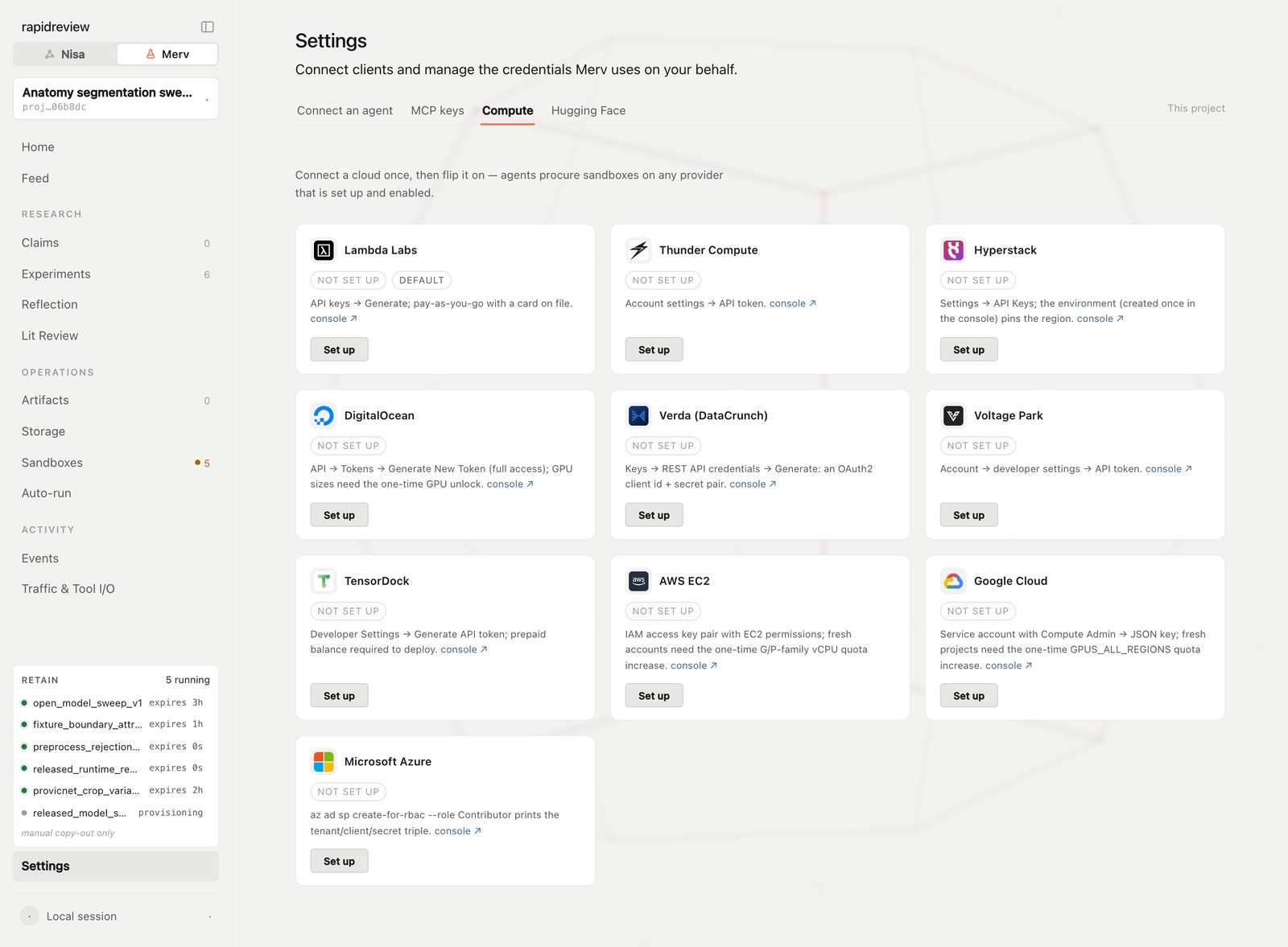
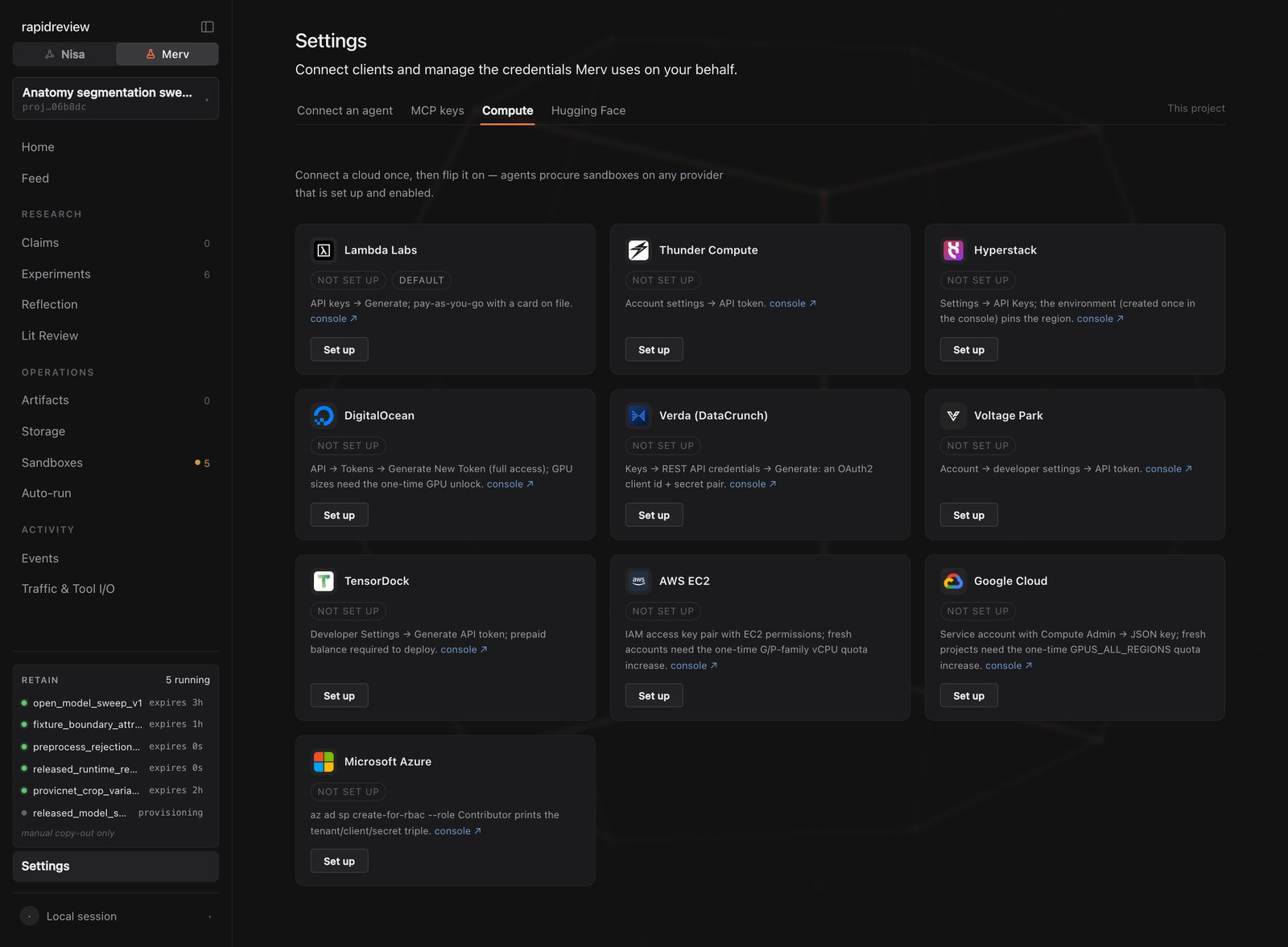
Settings → Compute: one card per provider, with credentials, verification, and a daily limit.
How the agent gets a machine
You don’t request machines yourself. The agent does it through thesandbox-operation skill:
- It calls
sandbox.optionsto see what your enabled providers offer. Each option is tagged with the provider that serves it and, where the provider exposes one, a price. - It picks the smallest option that fits the run and calls
sandbox.requestwith that option’s provider values and its public SSH key. - While the machine is
provisioning, it pollssandbox.getat the interval the brain advises. It never loops onsandbox.request.
You say
Run long jobs with merv_run
Anything longer than a few minutes runs through the wrapper Merv installs on every sandbox at bootstrap:merv_run detaches the job from the SSH session, so it survives disconnects, and writes a durable receipt the agent can read back. Labels are one-shot. The agent waits with the watcher rather than a polling loop, and when the run settles it reads both status and exit_code — finished is not the same as succeeded. How each client waits is on Long runs and waking.
Two directories matter on the machine:
Bring the evidence back
Nothing is copied off a sandbox automatically. Before the machine goes away, the agent retrieves what matters:sandbox.pull_outputsreturns a command the agent runs on its own machine, with its private key, to copy files down.- Heavy files — checkpoints, datasets, logs over roughly 10 MB — go to object storage instead. The agent computes the sha256 and size, calls
storage.submit, runs the upload command it returns, and confirms withstorage.find. - Artifacts must exist locally before
artifact.submit. The brain never reaches into the sandbox for them.
Extend or release
Watch and steer from the UI
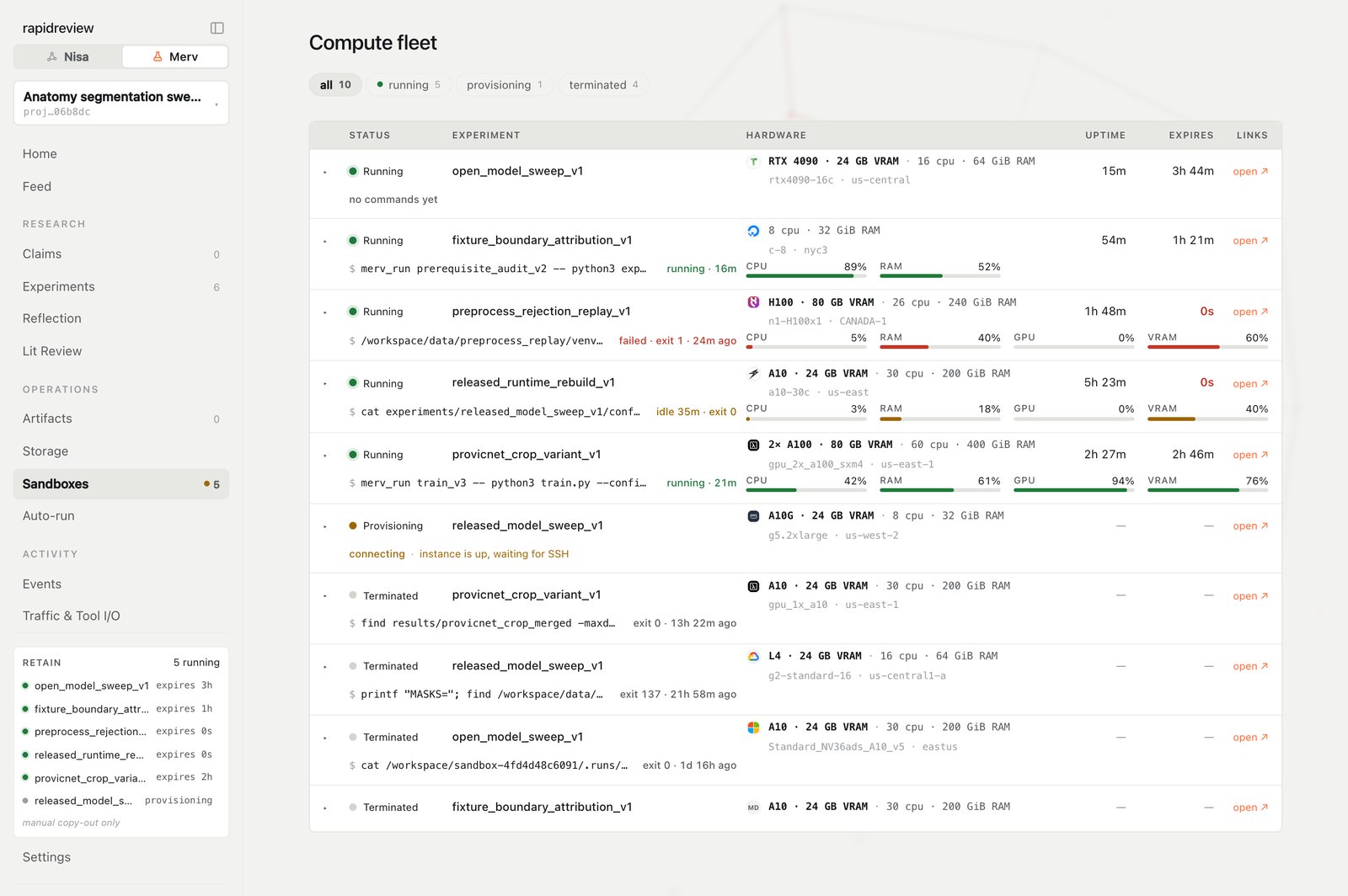
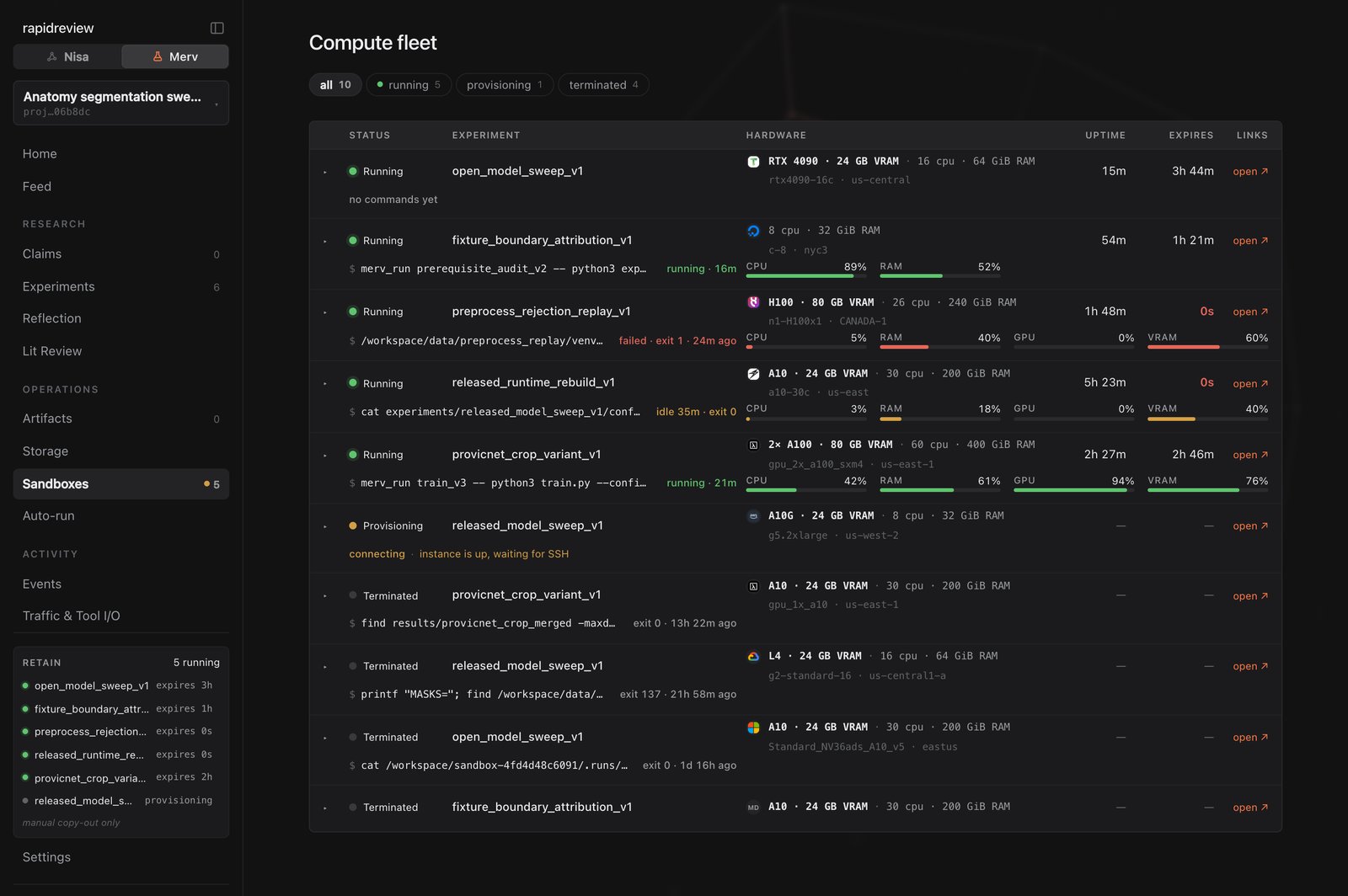
The Sandboxes page: every machine, its current command, utilisation, uptime, and time to expiry.
When a run is interrupted
If infrastructure interrupts a run while the approved plan still stands — the machine dies, the provider fails — the agent recordsretry_running with evidence and replaces the machine. A planned retry is only for a changed design, and its outputs stay separate from the original run’s.
Next steps
Sandbox providers
Credentials, environment variables, and quirks for all eleven providers.
Long runs and waking
How each client waits for merv_run without burning its context.
Sandboxes
Leases, receipts, and why nothing is copied back for you.
Artifacts and storage
Where evidence lives and how heavy files move.